
QUOTE OF THE DAY
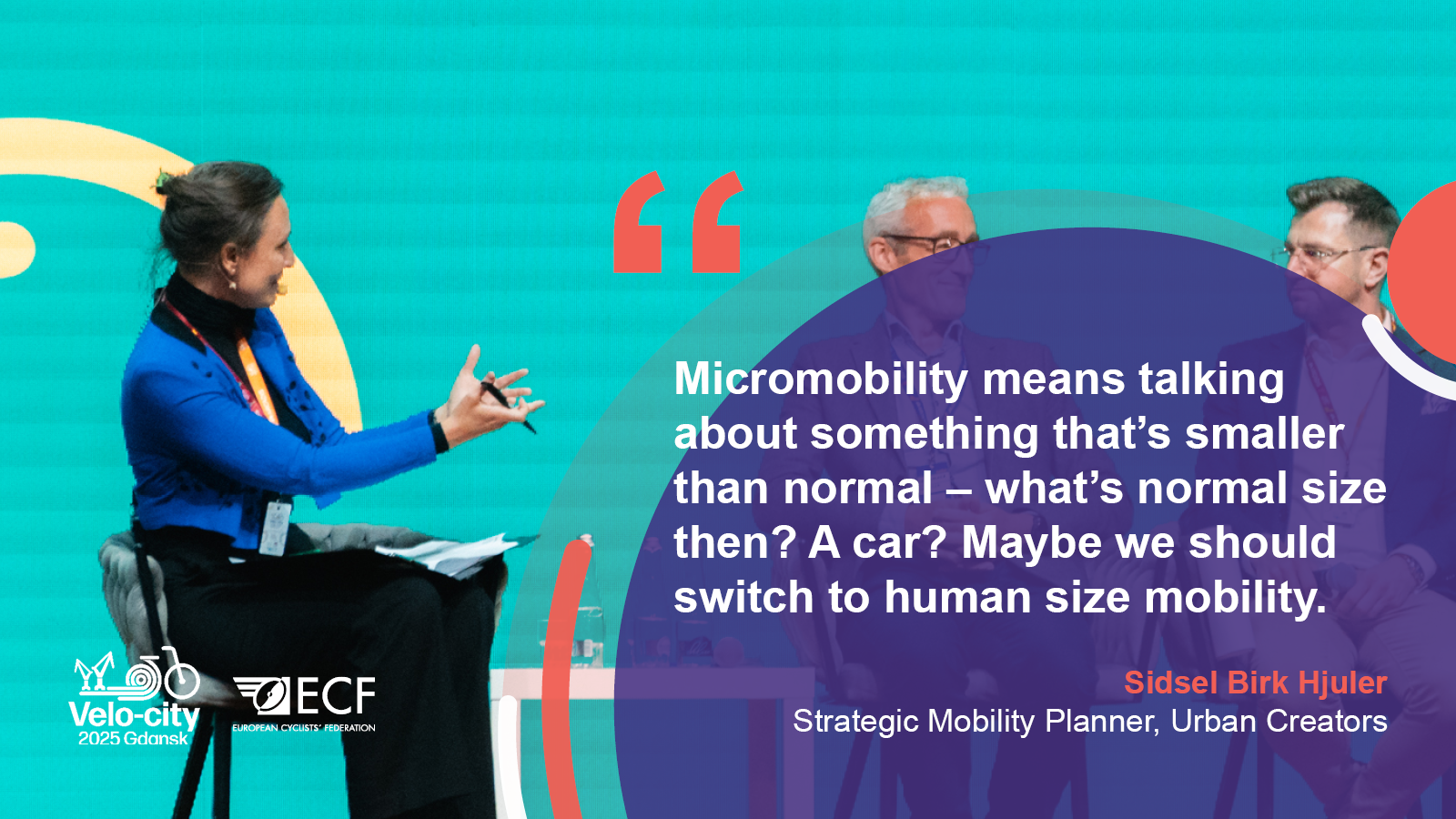
Micromobility means talking about something that’s smaller than normal – what’s normal size then? A car? Maybe we should switch to human size mobility.
Sidsel Birk Hjuler
Strategic Mobility Planner, Urban Creators & ECF Board Member
Plenary 4: Cycling for Joy and Health
The third morning of Velo-city opened with an uplifting and thought-provoking session on the power of cycling to improve wellbeing, build community, and support sustainable mobility. With Gdańsk located at the junction of three EuroVelo routes, the focus on tourism, leisure and everyday cycling felt especially timely.
Moderator Łukasz Wysocki, President of the Gdańsk Tourism Organisation, introduced a panel that moved from local perspectives to global reflections. Lucy Saunders, creator of the Healthy Streets approach, offered an interactive introduction to the tool (surveys.healthystreets.com), which measures how well streets serve people of all ages and abilities. She called for empathy-driven policy and suggested cycle training for city officials and planners to better understand the daily realities of those who ride.
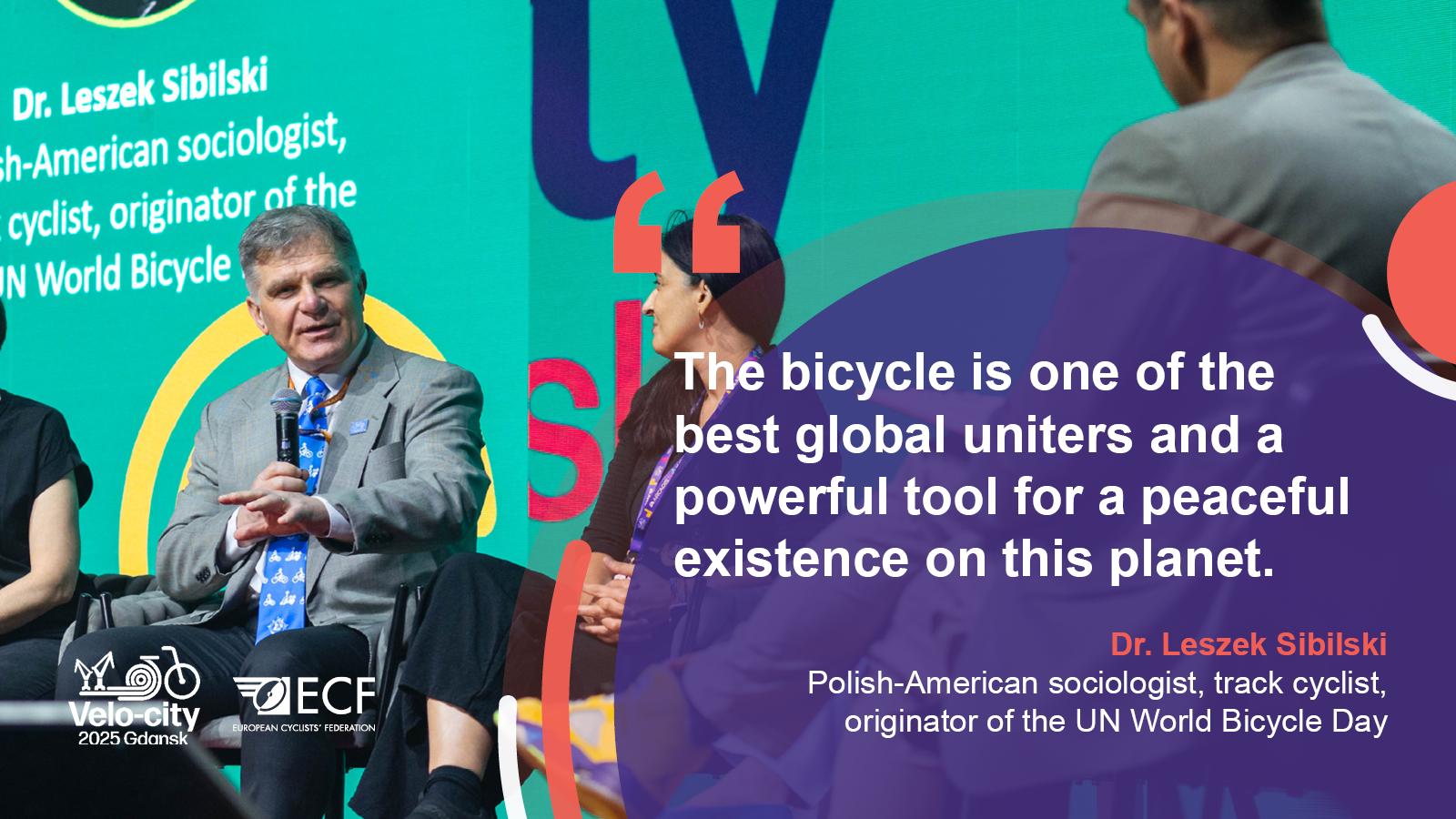
Dr. Leszek Sibilski, sociologist and originator of UN World Bicycle Day, delivered a personal and powerful reflection on cycling as a force for human development, stress relief, creativity and stronger relationships. “Cycling makes us better human beings,” he said.
Henna Palosaari of the Finnish Centre for Cycling Tourism warned of a cultural shift in Finland, where fewer children are cycling to school. “We are losing this culture,” she noted, calling for inclusive messaging, visible diversity among cyclists, and a focus on joy: “We remember how we felt, not what we did.”
Vanessa Pérez Miranda, representing UIC’s Latin American region, shared her transformation from skeptic to everyday rider and drew parallels between bikes and trains, both facing challenges of limited space and slow change. “But laws and mentalities are shifting,” she added.
From a regional perspective, Agnieszka Baranowska of the Pomeranian Voivodeship presented Poland’s progress on improving cycling infrastructure, including new bike-friendly trains and continued improvement of the EuroVelo network. “We’ve given people the tools — now we need to help them use them,” she said.
The session closed with Małgorzata Wilk-Grzywna of the Polish Tourism Organisation announcing Poland’s candidacy to host a National EuroVelo Coordination Centre—an important step toward a more connected and coordinated cycling landscape.
Thursday's session highlights
IN-FOCUS
Cycling tourism’s contribution to the Sustainable Development Goals: positive health and CO2 emissions savings
Making a case is only as strong as the data behind it— and cycling tourism in Europe is no exception. While the sector is booming, solid data shows how it truly supports sustainable development goals.
ECF's Holger Haubold opened with national reports EuroVelo uses to measure impact. Christian Tänzler highlighted how different cycling tourists bring different economic returns—daytrippers alone spent €14–15 billion in Germany in 2023, compared to the €2-3 billion spent by short trip travelers. In Slovenia, Staša Kraljič showed how cycling reduces CO2 emissions and sick leaves, though issues like dual pollution and green hushing persist. Philippe Marchina’s research in France found asphalt to be the most sustainable greenway surface because of its durable properties, comparatively low CO2 footprint, and low residual construction process. Finally, Erzsébet Pénzes shared how Hungary’s children’s cycling camps build skills, confidence, and bring income to local communities. All speakers agreed: data matters, but understanding behavior is key.
Cycling to school – a showcase of programmes, infrastructure and policy
With “You have to start when the wheels are small to make a big impact later,” Thomas Zaw from the Province of Groningen set the tone for an extended showcase of school cycling initiatives. Speakers shared how they're teaching children to ride, fix their bikes, and navigate traffic—while also building long-term programs and fun campaigns like Gdansk's Cycling May that help make cycling a way of life.
The consensus: kids take to cycling naturally once you get them in. As one speaker put it, “Kids hate to sit for too long”—they’re ready to ride. The bigger challenge is convincing parents to let them cycle independently. And that's a missed opportunity, since cycling gives children freedom, independence, and a healthy confidence boost—echoing Henna Palosaari’s touching remarks in the morning plenary.
Another tough spot? Funding. Everyone loves these projects once they see them, but it’s hard to express their value in numbers. One suggestion from the speakers: make kids your best ambassadors, find shared goals with cities and funders, and frame cycling to school not just as transport—but as something that benefits the whole community.
The economic impact of cycling – how countries can benefit from their cycling sector
Cycling is not just a tool for health and sustainability—it’s a growing economic force. This session showcased how countries like the Netherlands and Belgium have mapped the value of their cycling sectors, revealing contributions of €1.2 billion and €951 million respectively. Speakers highlighted the rapid growth of innovative subsectors such as bike leasing, sharing, and last-mile logistics. These industries thrive when backed by stable, supportive policy environments, with calls for national cycling strategies to include a dedicated pillar on the cycling economy. The panel stressed that every level of government must treat bikes—and especially e-bikes—not as leisure goods, but as essential transport. From data-driven bike sharing models to corporate leasing schemes that help people access high-quality bikes, the discussion revealed how cycling also supports local businesses and brings people back into work. Internationally, cycling is a competitive export opportunity, as seen with the Dutch Cycling Embassy. Looking ahead, industry leaders urged governments to continue fostering innovation and consumer-oriented solutions to unlock the full potential of cycling as an economic driver.
How can we make the European cycling data dream come true? Latest news on standardisation efforts within NAPCORE
The dream of a unified European cycling data standard took shape through collaboration in the Orange Room. Opening with a call to arms (and handlebars!), the first speaker laid out a roadmap of recommendations for standardising everything from parking data to real-time route updates, urging that “whenever there is work on static data for cycling, always add the real-time component.” The session quickly turned from presentation to participation, as attendees rolled up their sleeves to brainstorm solutions around infrastructure, real-time updates, parking, and counting. From Wallonia’s push to bridge official and OpenStreetMap data to calls for EU-wide compatibility, the session underscored that standardisation isn’t just red tape. After all, connected data means connected cities.
One year of implementation of the Pan-African Action Plan Active Mobility
After accepting the ECF Award for the Best Active Mobility Initiative on Tuesday, Jordi Bosch Pla led this dynamic session on the trophy-winning Pan-African Action Plan for Active Mobility (PAAPAM) in the Green Room. He introduced the plan’s mission to transform mobility across Africa by prioritising non-motorized transport, then handed over to Mounir Khamali and Vivian Aborah. Khamali, social project executer at Pikala – that means ‘bike’ in the local dialect – stems from Morocco and Aborah, who works for the Sekondi-Takoradi Metropolitan Assembly, hails from Ghana; two of the five countries PAAPAM is currently being implemented in. Both speakers detailed their challenges in mainstreaming cycling as a mode of transport and their plans on how to overcome those challenges while using PAAPAM as a catalyser.
After that, it was the participants’ turn: in groups, they were given a fictional city, a PAAPAM priority and 25 minutes to come up with the best possible solution for solving their locations’ most pressing issues. A great way to not only experience the necessity for initiatives such as PAAPAM firsthand, but also to connect and discuss with other Velo-citizens.
Plenary 5: From ‘Auto Empire’ to Just Transition
This powerful session brought together experts from across Europe to question the assumptions that shape our streets and our societies. From “motonormativity” to the under-regulation of motor vehicles, speakers exposed the cultural, legal, and linguistic double standards that continue to prioritise cars over people.
Ian Walker (Swansea University) urged the audience to see cities through fresh eyes, comparing driving to smoking—dangerous, harmful, yet still widely accepted. He reminded us that “what we see around us tells us what’s normal,” and that our environments are key to shaping attitudes. Skye Duncan challenged the language of planning, asking whether we need a Department of Public Space rather than Transport, and highlighting the importance of designing from the perspective of children and older people.
Sidsel Birk Hjuler from Urban Creators introduced the concept of “human-sized mobility” and warned against replacing one form of monomobility with another. Meanwhile, our Ceri Woolsgrove called out the regulatory imbalance between cars and e-bikes, likening the unchecked power of the automobile to tobacco or alcohol—products that come with real public health consequences.
Director Gdańsk Public Transport Authority, Lukasz Klos shared how public attitudes have shifted over time, with once-controversial measures like 30 km/h zones and paid parking now broadly accepted. His takeaway: change is possible, but communication is key. “People need time and clarity to understand why street transformation matters.”
The best of the rest
In partnership with Cities for Better Health (Novo Nordisk), we administered the second edition of the Velo-city travel grant! The 2025 edition of the grant facilitated and supported the attendance of twelve conference speakers and participants from developing economies, as a means to increase geographic diversity and inclusion in the conference programme.
After a tense finale, Catherine Elliot from E-Bike City won the Smart Pedal Pitch 2025. Congratulations to her!

Fun zone
COMING UP ON THE FINAL DAY...
We can't believe how quickly Velo-city 2025 has gone by! With the final day of the conference approaching tomorrow, it’s almost time to say goodbye. But first, don’t miss these exciting events following the final plenary "Cycling to Boost the Economy and Save Energy."
- The Velo-city 2025 Scavenger Hunt comes to a close, with the winner riding off in style on a sleek yuzu lime-coloured Brompton.
- Ready for a cosmic perspective on cycling? Don’t miss an intergalactic visit from space experts Ytilibom and Ecaps at 10:00 in the Yellow Room, as they explore how Earthlings use (and misuse) urban space — with a few surprises along the way.
- Don’t miss today’s closing ceremony as we officially pass the baton from Gdańsk to Rimini in 2026. It’s a moment to celebrate everything we’ve shared this week—and to get a first glimpse of what’s ahead for next year’s edition on the Adriatic coast!
FURTHER READING
Velo-city 2025 Gdansk: Tuesday Daily Report – Energizing Solidarity
Velo-city 2025 Gdansk: Wednesday Daily Report – A sea of cyclists rolls into town


