
QUOTE OF THE DAY
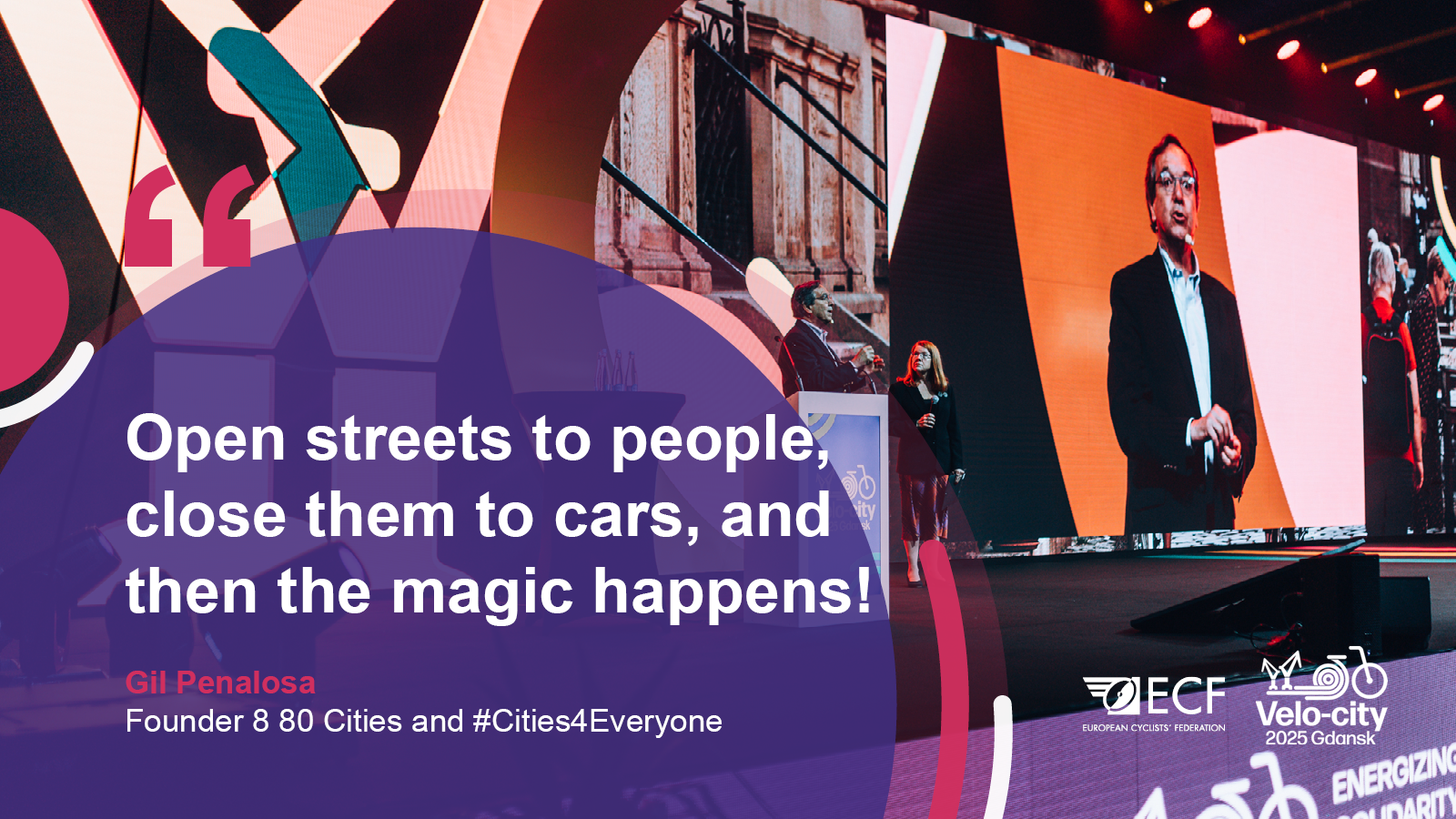
If citizens of the future are to be in control of their cities, then they need to be at the table with all stakeholders. If you’re not at the table, you’ll be on the menu!
Gil Penalosa
Founder 8 80 Cities and #Cities4Everyone
Opening ceremony and plenary 1: Energizing Solidarity
After an exciting start to the event, a performance by local cycling acrobats “Flying Bikes”, the Master of Ceremonies, Maciej Kautz, introduced the Mayor of Gdańsk, Aleksandra Dulkiewicz, as the first speaker. Mayor Dulkiewicz detailed how campaigns like Cycling May, that started locally in Gdańsk and today sees over 300.000 students across the country cycle to school during the month of May, transformed Gdańsk into Poland’s cycling capital – not a revolution but a peaceful evolution.
Her speech was followed by ECF president Henk Swarttouw, who urged cycling advocates to take the lead and step up while governments step back. Mieczysław Struk, Marshal of Pomorskie Voivodeship, followed by stressing that bicycle mobility is a right, not a luxury, and outlining how the region works toward equal access for all.
Gil Penalosa tied things up as the last keynote speaker. After an introduction by ECF CEO Jill Warren, the founder of 8 80 Cities and #Cities4Everyone used the examples of Paris, France and Bogota, Colombia to illustrate how not talking about cycling can actually be beneficial when promoting it. It’s not about cycling, said Penalosa, but about better cities. His message was clear: do the things that matters to people to get a seat at the stakeholder table – because “if we’re not at the table, we’ll be on the menu.”
Tuesday's session highlights
IN-FOCUS
Pedal and Tracks: Overcoming Barriers to Seamless Rail Travel for Cyclists
#CyclistsLoveTrains2025
ECF’s much-anticipated report on the bicycle-friendliness of long-distance trains was unveiled today, naming Belgium’s NMBS/SNCB and Switzerland’s SBB as joint leaders, with Hungary’s MÁV-START close behind.
Fabian Küster, ECF’s Director of Advocacy and EU Affairs, and policy intern Jacob Rozenburg conducted the research and shared key insights during a session moderated by journalist Laura Laker.
While the overall trend is positive, there’s still much to learn from top performers. Denis Brachet, Intermodality Manager at NMBS/SNCB, credited Belgium’s strong cycling culture and a customer-first mindset for their success. He also announced plans for new rolling stock by 2030, designed with cyclists and people with disabilities in mind.
Jon Worth, founder of the #CrossBorderRail project, emphasised that such progress must be backed by the right political framework.
Spain is one example that is taking action seriously. A royal decree is in the works which would mandate at least eight spaces per train, according to Sheila Ferrer, the national coordinator of the country's cycling office.
Tools to unlock cycling as a mode of transport in rural areas
The session explored practical ways to make cycling viable beyond cities, challenging myths that rural cycling is impractical due to distance or lack of interest. Ida Nygaard showed how Denmark’s Cycle Superhighways boosted cycling especially in rural areas. Monica Scigliano shared Cycling UK’s findings that rural communities do want to cycle, but face barriers like safety concerns and poor infrastructure. Panelists stressed that giving everybody access to active, affordable transport should matter more than simply increasing cyclist numbers. Catia Chiusaroli highlighted Bologna’s Bicipolitana as a model of rural municipal cooperation, with shared standards avoiding duplication. Susanna Maggioni (FIAB) described how a railway turned cycle route became a key commuting link and local economic driver. Chloe Charrat (FUB) concluded that rural areas offer strong cycling potential—with many short trips and real community interest. Unlocking this potential can boost both mobility and rural vitality.
Cycling for all? Research on social justice and the perceptions of cycling
This academic session explored how different groups perceive and how they are affected by cycling policies and practices. The research contributions analysed how people evaluate pro-cycling policies in terms of social justice; they explored gender and income disparities in cycling participation; and they looked at public perception and media framing of cycling. Ways to encourage and enable pregnant people, young families and children to cycle were also analysed.
Women in cycling – a catalyst for more cycling
In the Blue Room, Fatima Mimouni moderated a very lively and interactive discussion about the hardships women in cycling face and how to overcome them. All three panelists – ECF CEO Jill Warren, Charlotte Guth of the City of Paris, and Heba Mousa, co-founder of the Tabdeel Centre for Cycling Urbanism in Cairo – recounted how they quickly realised the need for inclusivity in this rather male-dominated area. Warren detailed ways to get there: “Stand up for your female colleagues, check your own biases and call out bad behaviour”. The session ended with a very active Q&A and one clear take-away: social barriers still keep women, and teenage girls in particular, from all over the world from riding their bikes. Strong role models like the speakers in this session will be needed to combat this trend.
For geeks and dummies: Improving cycling safety and infrastructure through data
In the Red Room, data took centre stage as the unsung hero of safer, smarter cycling cities. Whether you’re into spreadsheets or just learning the ABCs of APIs, this session proved that data isn’t just for geeks but a game-changer for everyone. From icy winters warmed by cycling campaigns to AI-analysed risk maps and teenager-tested school routes, the speakers showcased how pixels and patterns can pave the way to a cycling paradise. The common thread? Turning raw numbers into real impact. Whether through crowdsourcing apps, digital infrastructure overlays, or decades-old climate surveys, the message rang clear: data must not only speak but it must also persuade. As panellists emphasised, the next goal is turning insights into influence through storytelling, strategic comparisons, and media-savvy narratives that shift gears in policy. In this session, data didn’t just count, it meant something.
Bicycle complexity – from fat bikes to e-bikes and adapting regulations to today's bicycle
E-bikes were the hot topic for this session, which apparently faces stigmatization in various places like London and Amsterdam, albeit "fat e-bikes" for the latter. Panelists agree that media coverage plays a huge role in the development of its negative image. But in exceptional cases like Vienna, it's the government that's slightly problematic—there, mopeds are considered bicycles by law, complicating safety regulations for "traditional cyclists" and pedestrians. On the bright side, there are movements like the Cycling UK's e-bike positive campaign that aims to become a voice for this mode of transport that many people use in everyday life.
Plenary 2: Shaping the Urban Transformation Together
The challenge of transforming cities into sustainable, livable spaces requires collaborative effort across various sectors, ensuring that transport, health, environment, and urban development initiatives work in harmony. Truly, synergy was the theme that surfaced in the second plenary featuring a diverse panel of experts from Europe and Africa.
Moderated by POLIS Network's Karen Vancluysen, the discussion revolved around obstacles such as working across regions, the advantages of being data-driven and the strategic approaches to goal-setting.
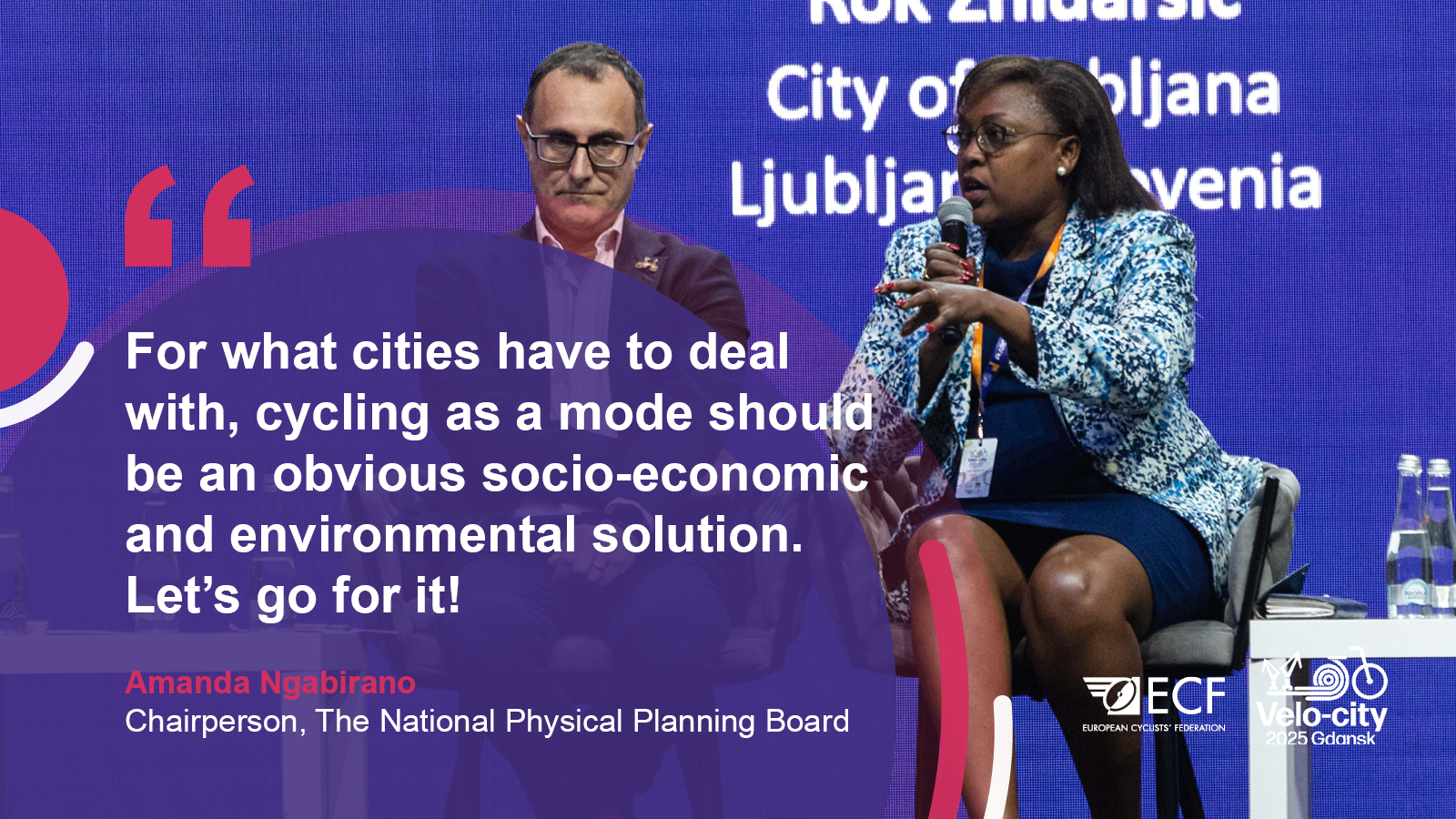
Synergies among authorities, in communities, and across industries are the key factors to drive the active travel movement forward. For example, Transport for London (TFL) is one example of an authority that has a broad vision for integrating public transport and cycling. Meanwhile, in Uganda, they are improving communications with more community based stakeholders for better coordination. Across countries and continents, panelists all agreed that within the sustainable mobility sector, it is better to see each other stakeholder as a teammate rather than a competitor.
Only then can real, impactful change take place.
Winners of the ECF Awards 2025
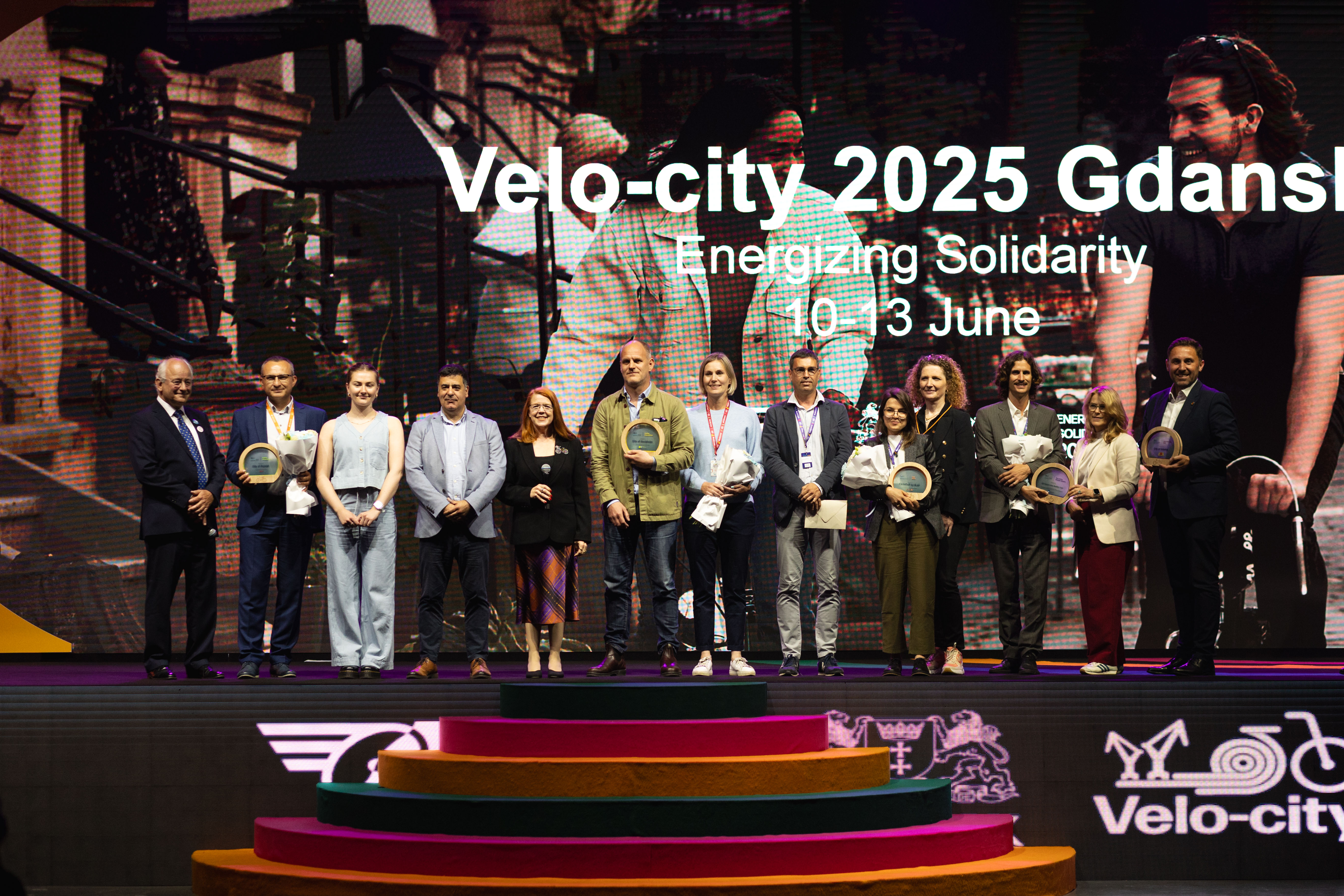
The ECF Awards ceremony at Velo-city 2025 Gdańsk was a huge success! We are delighted to celebrate the following winners for their achievements in cycling promotion across Europe!
- City of Poznań for the Cycling Infrastructure Award, sponsored by Arup “We shape a better world”
- International Road Assessment Programme (iRAP) for developing the CycleRAP for the Road Safety Award, sponsored by Geveko Markings “100 years of passion for road markings and traffic safety”
- City of Stockholm for the Cycling Improvement Award, sponsored by Eco-Counter “Providing communities with the necessary tools to collect and communicate bike and pedestrian count data”
- UNEP Sustainable Mobility Unit, the UN-Habitat Urban Mobility Team and the WHO Regional Office for Africa for their Pan African Action Plan for Active Mobility for the Best Active Mobility Initiative Award, sponsored by the Netherlands Ministry of Infrastructure and Water Management “The Ministry of Infrastructure and Water Management is committed to improving quality of life, access and mobility in a safe and sustainable environment”
The best of the rest
On Monday, ahead of Velo-city 2025, representatives of ECF’s Cities & Regions for Cyclists network met in the historic Great Wety Hall of the Main Town Hall of Gdansk. The CRC Network Day 2025 was co-organised by ECF together with the City of Gdansk, a CRC member, and was kindly sponsored by the Dutch Cycling Embassy. Members later gathered at the Imperial Shipyard in Gdansk for an evening of networking, catching up with the ECF community and kick-starting the Velo-city conference week together. The event was kindly supported by Stocznia Cesarska Development and Decathlon!
Interested in winning your very own Brompton folding bike? Spin the wheel of fortune at the ECF booth (B15) and complete the challenges – participate several times and put your most creative foot forward to increase your chances!
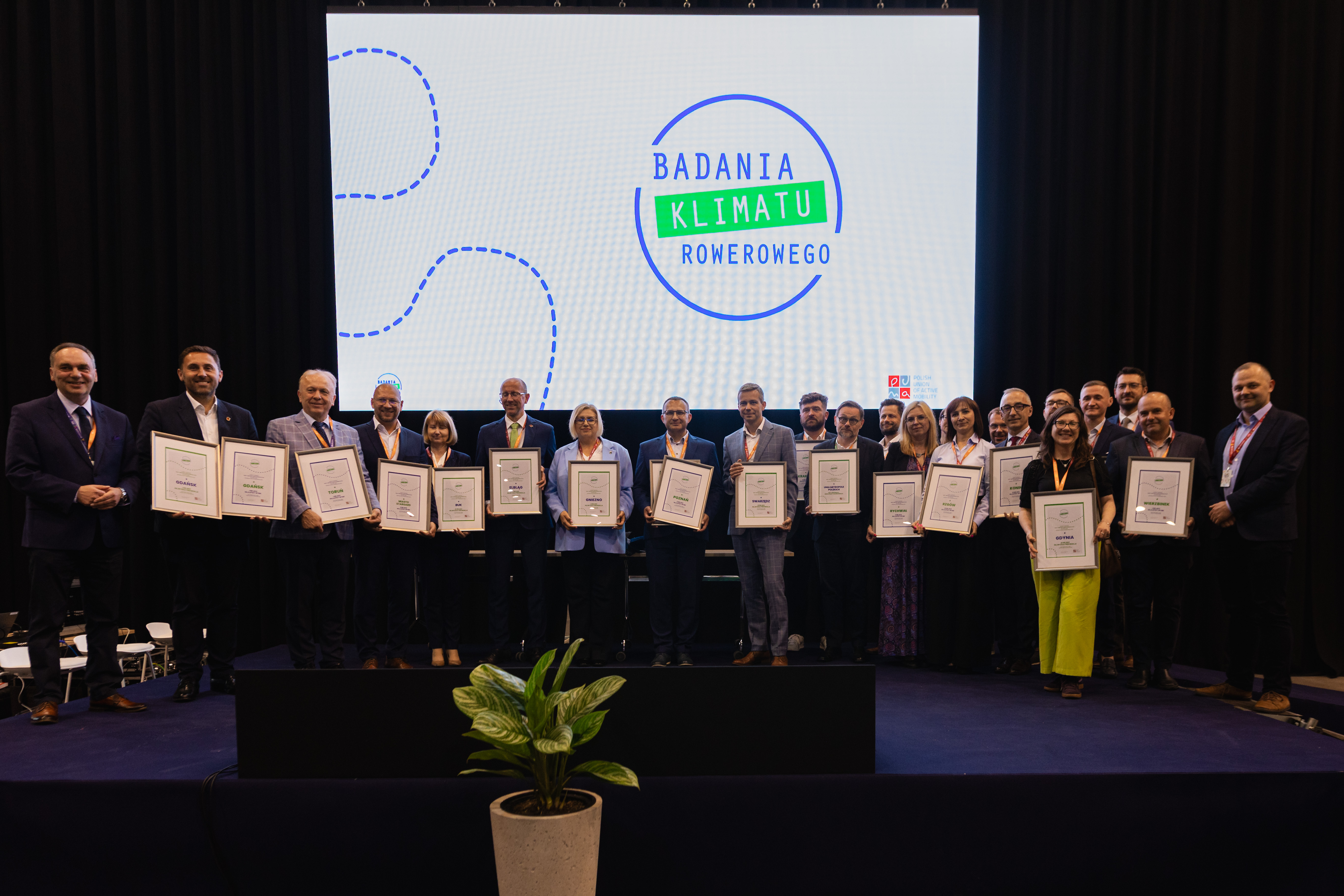
After the last plenary, Rafał Glazik of the Polish Union of Active Mobility (PUMA) hosted the Bicycle Climate Test Awards Gala on the Freewheel Stage. 22 different Polish cities were ranked by their bike-friendliness – how did your favourites hold up?
COMING UP ON DAY 2...
With the first day of Velo-city 2025 behind us, let us now look at all the highlights to come tomorrow on day 2!
- Plenary: The Social Power of Cycling – Dealing with Bikelash from 09:00 in the Purple Room.
- Saddle Up to Transform Cities for Better Health and More Inclusion from 10:45 in the Green Room.
- Bike2Green: Encouraging everyday cycling through gamification and rewarding from 16:00 in the Blue Room.
- Meet fellow Young Professionals from across the globe for an engaging, fun, and energizing networking session from 16:00 in the Orange Room.
- Movie screening: The Wheels of the Future (les roues de l’avenir) at 17:00.
- The famous Velo-city bike parade (19:00 – 22:00).
- Grab a coffee during one of the breaks tomorrow, and make sure to visit the Freewheel stage to learn more about inspiring initiatives and academic research on cycling.


