
QUOTE OF THE DAY
Have a heart like a giraffe. And remember, the giraffe can reach places no one else can.
Piotr Kuropatwinski / Philippe Crist
Senior Expert of Cycling Policy, Polish Union of Active Mobility / Mobility thinktavist
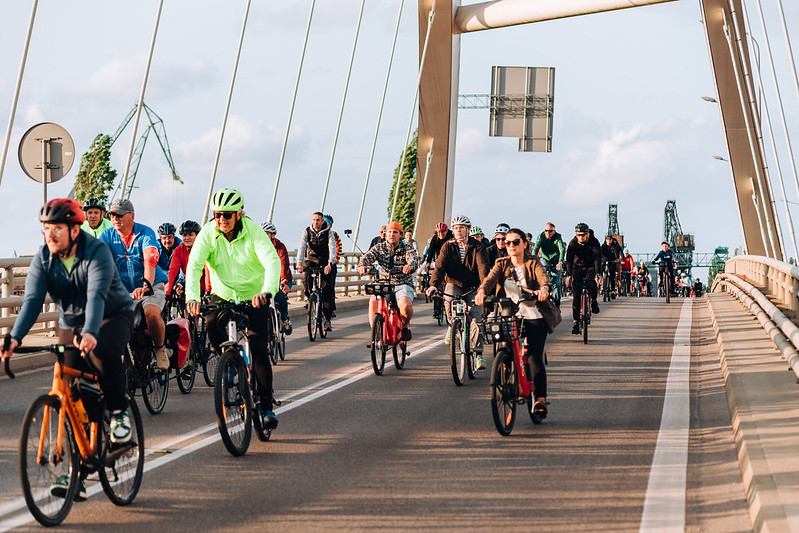
Bicycle parade in Gdansk
Check out some of the best snaps from Wednesday's bike parade and afterparty!
Plenary 3: The Social Power of Cycling – Dealing with Bikelash
The second day of Velo-city was off to a great start with a thought-provoking plenary on bikelash. While a session on the topic was also held yesterday, today's deep dive provided rich insights on the roots of this opposition and how we can break through it.
Moderator Philippe Crist began by asking audiences to reflect on their personal bikelash experiences, many of which typically elicited fear, frustration, and anger. Peter Norton's presentation revealed that cars also faced similar reactions before becoming the norm many years ago, a symbol of urbanity. Since then, cyclists became the new radicals despite being widely used.
Discussing the current landscape, Céline Scornavacca talked about France where 34% of bikelash involves physical violence, typically perpetuated by men and covered largely by mainstream media. Meanwhile, in Tirana, Albania, Iden Petraj said that bikelash stems from citizens' car dependence and political opposition, hindering the growth of bicycles’ mobility share.
Moving west, Canada faces similar political challenges, particularly in Ontario with the region's current populist premier. But according to Eleanor McMahon, former MPP and founder of Share the Road, understanding people's anxieties and fear is key to unlocking change.
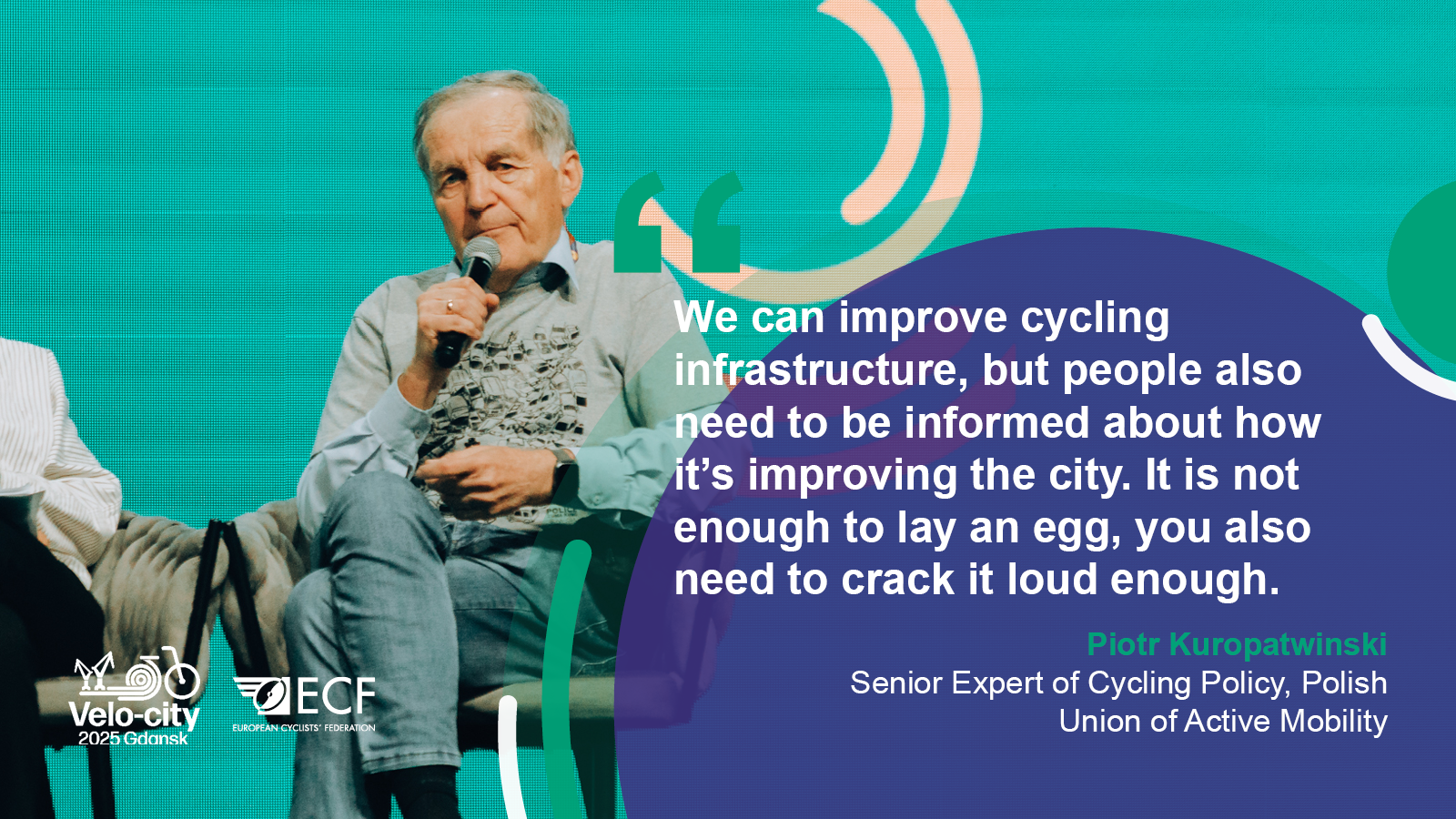
Panelists then shared various solutions from their home country, highlighting the importance of stories and statistics in reshaping the narrative against cyclists. Piotr Kuropatwinski, a senior expert of cycling policy based in Gdańsk, emphasized that "mindset is the most important thing, infrastructure is a tool." True enough, Poland is seeing more pro-cycling movements from social media to the streets.
The session ended with a word from Stanislaw Bukowiec, Poland's Secretary of State in the Ministry of Infrastructure. He shared their best practice of thinking locally while working internationally to ultimately create tailored solutions.
Wednesday's session highlights
IN-FOCUS
Saddle Up to Transform Cities for Better Health and More Inclusion
Echoing Gil Penalosa’s takeaway from yesterday: this workshop wasn’t really about cycling – it was about health. Which, of course, made it all about cycling. As Jasper Schipperijn, Professor at the University of Southern Denmark, explained, physical inactivity leads to 5.3 million deaths each year – and cycling is key to reversing that.
The call for a vélorution rang loud, with speakers presenting tools and interventions ranging from mapping cities' cycling potential to gathering street-level quality data and building the essential human infrastructure.
And the conversation didn’t stop there – in seven packed roundtables and an online Mentimeter, participants shared their success stories for creating healthier, happier, and more resilient communities.
Missed the session? No worries – a programme guide and toolkit by Cities for Better Health and BYCS is coming this October, packed with these solutions and more. Stay tuned!
Leaving no one behind: building inclusive communities
The wheels of inclusion were set into motion in the Yellow Room with heartfelt stories and practical insights proving that cycling is more than just transport. From Egypt to Poznań, the panel showed how bicycles can empower, educate, and equalise if we build communities where everyone has a seat in the saddle. As moderator Jessica Casagrande steered the Q&A, incisive questions revealed deeper truths: car culture still dominates perceptions of status, and underdeveloped areas often fall into “cycling black holes.” One speaker summed it up best: “Culture should go hand in hand with infrastructure change.” From inclusive parades to programmes educating young riders, each effort added a spoke to the wheel of equity. Inclusion, the panel agreed, isn’t a side path – it’s one of the main routes to resilient, bicycle-friendly cities.
Cycling advocacy in changing political landscapes
In this session, moderated by ECF Members & Networks Director Froso Christofides, representatives from ECF member organisations discussed how populism and the far right threaten cycling development in their countries and how they deal with this challenge. The panelists agreed that changing your messaging can make a decisive difference when dealing with headwind from governments. While climate arguments will not win over the right, points about health, safety and money from cycling tourism might. Despite the difficult situations in many of their home countries, all participants still feel optimistic about the future of cycling – Wim Bot (Fietsersbond) called it “pessimism of the intellect, optimism of the will”. Even where national governments push back against the bicycle, local governments and the population are often still very much in favour and can be valuable allies in mitigating the decline of national policies.
Developing accessible cycle routes for disabled cyclists and other diverse user groups
This session explored the multiple dimensions of accessibility in cycle tourism, stressing that inclusivity must extend beyond the cycle path itself. As moderator Florence Grégoire noted, "All of it needs to be accessible" – from transport connections and toilets to restaurants and accommodation along the way. Ewoud Lagring shared how Flanders is promoting barrier-free tourism through adapted bike rentals and engaging routes, noting that "most disabled cyclists said they would cycle more or start cycling if appropriate adapted bikes were more available." Wanda Nowotarska presented the work underway in West Pomerania to improve accessible cycling infrastructure, while Ben Foley of Wheels for Wellbeing reminded participants that disabilities can often be invisible and that new infrastructure must consider the full range of disabled users’ needs. The session made clear that inclusive design and clear information are key to ensuring that no one is left behind in the growing world of cycle tourism.
Bike2Green – Encouraging everyday cycling through gamification and rewarding
This session highlighted how gamification can boost cycling, showcasing results from the Bike2Green project, where over 1,300 Stockholm residents have earned rewards for cycling since March 2024. From logwalls to weekly challenges and monetary incentives, various techniques were tested to encourage daily cycling. But it wasn’t just about rewards – data collection played a key role. The technology tracked routes, start/end points, and safety perceptions, while rewards could be spent at local shops, benefiting both cyclists and the economy. Henrik Söderström from the City of Stockholm emphasized the value of going beyond simple counts to understand cyclist behavior. Pedro Vale Moreira from the City of Braga, using the same PinBike tech, echoed these benefits – especially the use of heatmaps to guide infrastructure investments. Will people keep cycling without prizes? Surveys say yes. The panel also showed the system’s flexibility—from tracking commutes and corporate rides to offering discounts on public transport or access to cultural events. Most importantly, adding game elements to everyday commuting makes cities more active, connected, and fun!
Developing accessible cycle routes for disabled cyclists and other diverse user groups
Disabled cyclists encounter a lot of difficulties to find information on the accessibility of cycle routes, both in terms of infrastructure and suitable accommodation. To be able to confidently go on a cycle holiday, a leisure trip or just a ride through a city that they do not know well, users of special cycles need to be sure that the route will be free of barriers and obstacles, that the width will be sufficient everywhere and that the surface will be solid enough. If they wish to go on a multi-day trip, they also need information on accessible accommodation offering ramps and lifts. Families with children, tandem users and other users with special needs may encounter similar difficulties, which should be addressed in the development of cycle routes to ensure inclusivity and to leave no one behind when it comes to the possibility of cycle travel. In this session, we will look at existing solutions: quality labels such as the EuroVelo Certification proposing a detailed assessment of infrastructure, services and communications and including a set of quality criteria adapted to the needs of disabled cyclists, as well as good practices.
The best of the rest
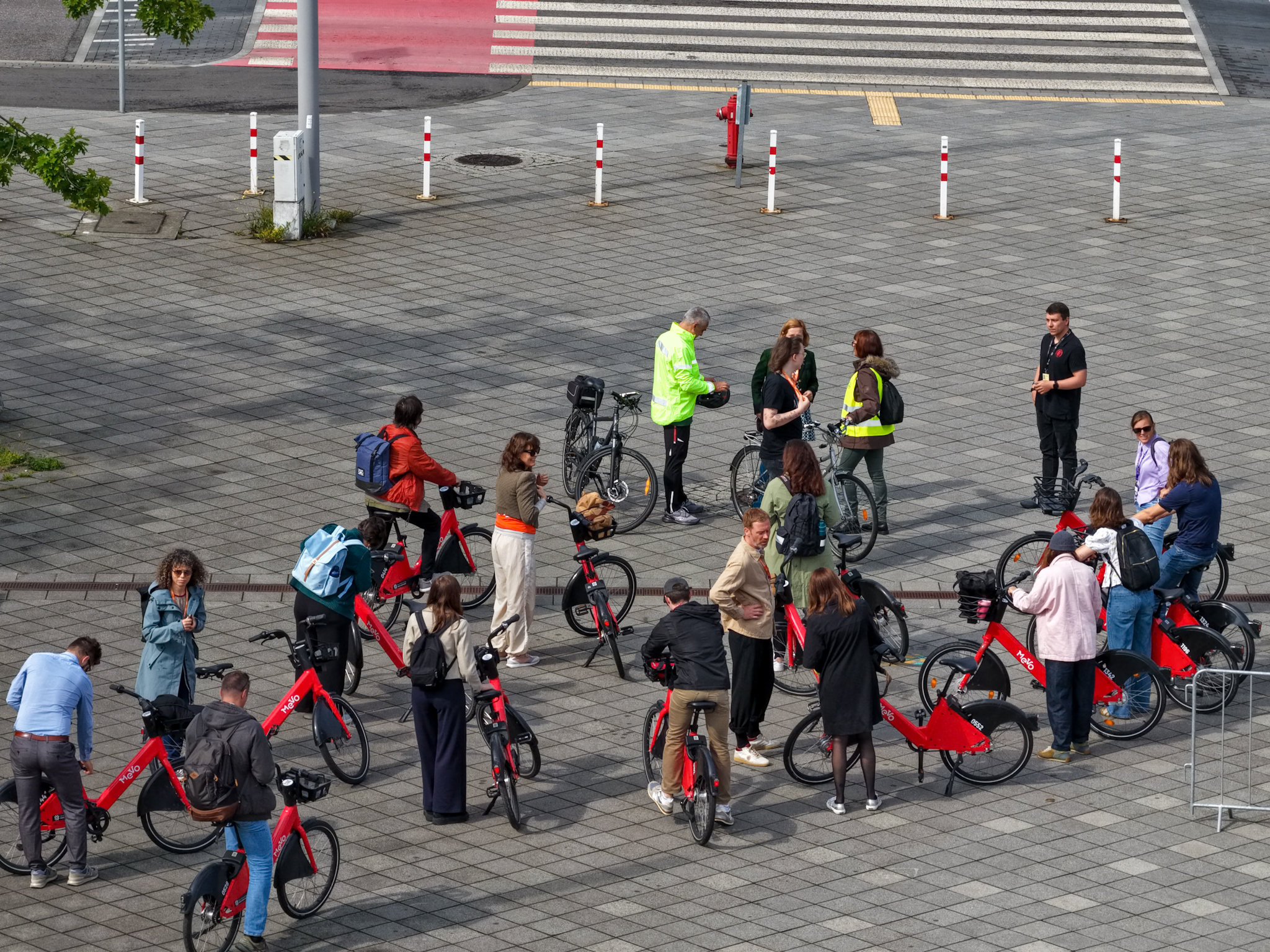
There was a bit of rain in the morning, but the rest of the day was luckily dry – great conditions for the many different technical visits organised by the City of Gdansk! Velo-citizens rode all over Gdansk to learn more about the cities’ cycling infrastructure, followed in the footsteps of solidarity and explored the beautiful landscape along the Iron Curtain Trail (EuroVelo13).
Before heading out for the Bike Parade, we were in for another special treat: the Purple Room turned into a cinema for a screening of ‘The Wheels of the Future’ (Les Roues de l’Avenir), followed by a short Q&A with Baptiste Lemaitre, co-writer of the film. Even the most seasoned cycling experts among us probably still learned a thing or two about putting the bicycle at the centre of our cities from watching this unmissable documentary.
High stakes over on the Freewheel Stage: From community apps that help children ride to school safely to high-performance racks that turn your average bike into a small cargo bike in just one click, the Smart Pedal Pitch semi-finalists wowed Velo-citizens and a special jury with their market-ready innovations. The products on display covered urban planning, intermodal data, bicycle theft and safety, showing just how smart cycling can be. Don’t miss out on the finals happening after Plenary 5 tomorrow!
Fun zone

COMING UP ON DAY 3...
Day 2 is over, but don’t be sad. There is still so much to look forward to in the next few days. Here are some top tips for day 3.
- Plenary: Cycling for Joy and Health from 09:00 in the Purple Room
- Cycling tourism’s contribution to the Sustainable Development Goals: positive health and CO2 emissions savings from 10:45 in Blue Room
- Plenary: From “Auto Empire” to a Just Transition + Smart Pedal Pitch Finals from 16:00 in the Purple Room
- Last chance to participate in the Scavenger Hunt and win that coveted Yuzu colour Brompton bicycle!
- Make sure to visit the Freewheel stage during the coffee and lunch breaks to learn more about inspiring initiatives and academic research on cycling.


