We kick off with travel reimagined
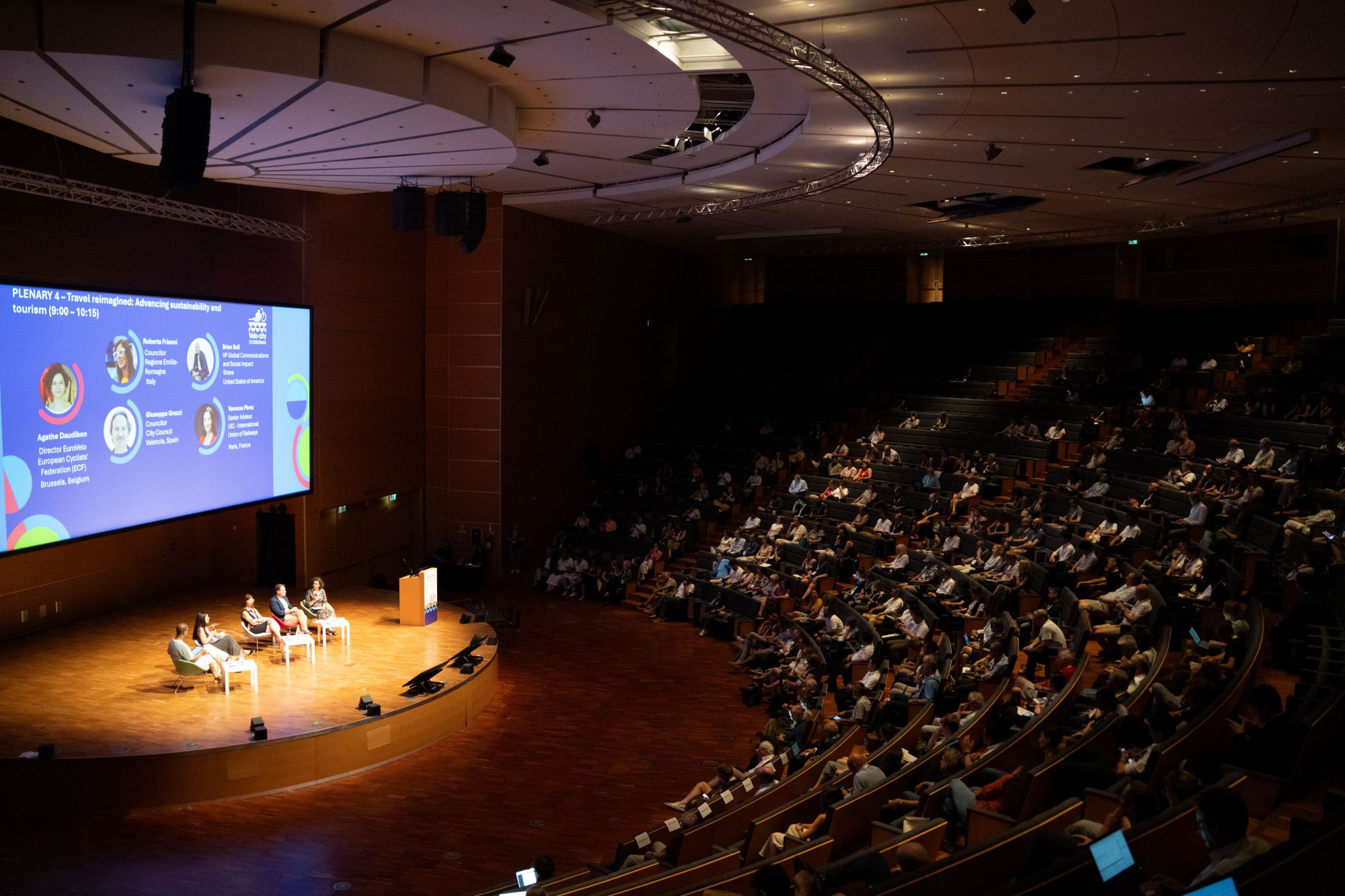
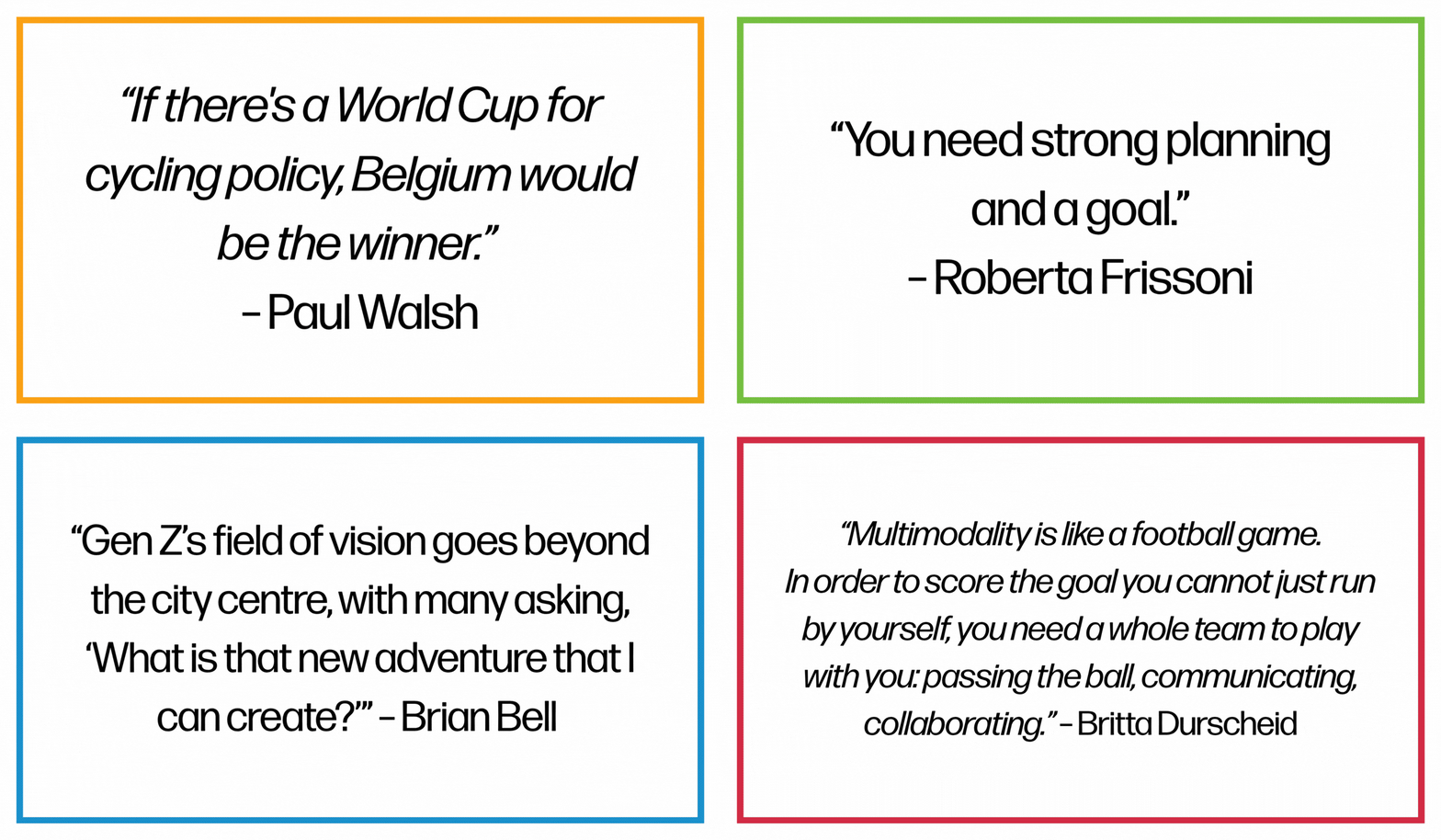
If sustainable tourism had a World Cup, cycling would emerge as one of the favourites. In her opening remarks, session moderator
Agathe Daudibon of the European Cyclists' Federation set the scene by highlighting the scale of the challenge. Cycling tourism already generates an estimated €44 billion in economic impact, while tourism accounts for 7% of EU GDP and supports 4.6 million businesses. With 80% of European tourism remaining domestic and EuroVelo usage increasing by 4% in 2025.
Roberta Frisoni, Councilor for the Emilia-Romagna Region, noted how in her region, cycling services have encouraged visitors to move beyond the beachfront to discover the wider region, while stressing that successful transformation requires “strong planning and a goal.” Talking through Valencia’s transformation,
Giuseppe Grezzi, Councilor from Valencia City Council, argued that sustainable tourism cannot be separated from residents’ quality of life, warning of the pressures associated with overtourism and housing.
Not surprisingly, multimodality was a recurring topic during the discussion. Speakers repeated that bicycles and trains are the perfect strike partnership.
Vanessa Pérez, Senior Advisor the International Union of Railways (UIC), explained how the sector has evolved “from avoiding bicycles to seeing them as an opportunity.” Strava Vice President,
Brian Bell pointed to two important trends: the rise of staycations and a growing appetite among travellers, particularly Gen Z, to seek authentic adventures. A standout example came from
Tokihiro Nakamura, Governor of Ehime Prefecture. Connecting islands across the Seto Inland Sea, the Shimanami Kaido has become one of the world’s most celebrated cycling destinations. Ehime has transformed itself into a cycling prefecture with international bicycle rentals increasing 50-fold, while inbound overnight stays have grown by 122.8% year-on-year. With the region set to host next year’s Velo-city conference, the crowd’s anticipation is already building.
Day 3: Session highlights
Getting the message across the pitch
Language builds our reality. The academic session on communicating the mobility transition was an eye-opening dive into the subconscious mechanics of language and how stakeholders can use them to convey a message.
Jana Busse showed how a successful urban redesign became politically contested through media coverage, while
Maria Cristina Caimotto explained how wording and implicit associations can reframe public understanding. Are cyclists vulnerable road users, or people exposed to greater risks from motorised vehicles? Fortunately, there are proven ways to overcome these blockers.
Sadhbh O'Neill drew lessons from climate communication: understand your audience, use their language, and work with trusted messengers. These remain our best tools for promoting cycling and cutting through the noise.
Tackling diabetes
The session featured stories of people living with type 1 diabetes and the importance of creating environments that enable healthier, more active lives. A former professional cyclist from Novo Nordisk’s ‘all-type 1 diabetes cycling team’ shared her journey, demonstrating that living with a chronic condition does not limit the pursuit of extraordinary achievements. An additional testimonial from Bari showcased local efforts to foster an active cycling culture among children and encourage healthier habits from an early age. The discussion of the broader importance of active mobility was underscored, with
Antonella Santoro noting that citizens in Bari lose an average of 76 hours of life each year sitting in traffic – equivalent to three days of holiday!
No own goals for nature
Asphalt or gravel? Can we remove trees to create a cycle path? These are some of the dilemmas that arise when developing cycling infrastructure with environmental sustainability in mind. “We are promoting something good, but are we not part of the problem sometimes?” asked
Florence Grégoire. The speakers explored how cycling projects can minimise their impact on protected areas and natural environments, highlighting three key lessons: collaborate with conservation experts, create green-blue corridors that benefit both cyclists and wildlife, and carefully plan surfaces, water management, long-term maintenance and route signage. Cycling infrastructure need not come at nature’s expense. And let’s not forget its wider benefits: reducing emissions, increasing environmental awareness and connecting people with nature. Many good practices already exist, and this
Climate Resilient and Inclusive Cycling Guide offers practical guidance.
The human touch to data
How can we leverage data to tackle our most pressing active mobility needs? This session’s success depends not on having more data, but on having the right data. In Rotterdam, a Space Accelerator programme helps the cycling administration analyse traffic nuisance, vehicle speeds, and tree density to guide tactical urbanism projects. Meanwhile, Zagreb combines public and private datasets to identify infrastructure gaps, while Eco-Counter uses a similar approach in Rimini to reveal differences between seaside infrastructure and the city centre. Milan’s “Sai Che Puoi?” project demonstrated how citizens can contribute, with over 2,000 volunteers using a web app to document illegally parked cars. Its success inspired similar projects in Munich and Perugia. Likewise, cyclists in Flemish Brabant shared experiences of the new F24 cycle highway through a Facebook group. Together, these examples highlight the enduring value of human creativity in data-driven solutions.
What else happened?
ECF x Cities for Better Health Travel Grant
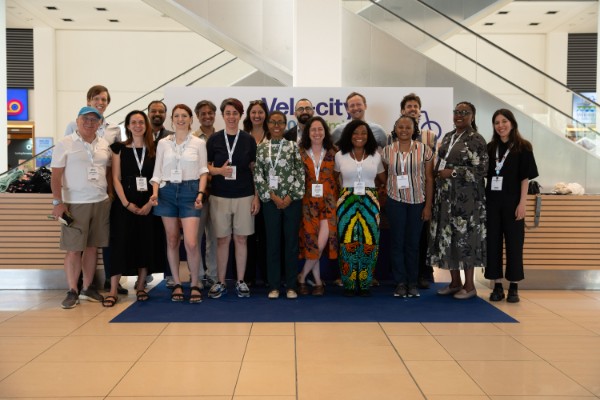
This year, the grant supported the attendance of more than 15 inspiring speakers. Beneficiaries from Argentina, Brazil, Ghana, India, Kenya, Lebanon, Malawi, Turkey, Uganda and Ukraine brought their knowledge and experience to the table, demonstrating what determined leadership can achieve for active mobility.
Multimodality is a team sport
What does multimodality actually mean? For the panellists, it went far beyond simply combining transport modes. Caroline Samponaro, Vice President of Lyft Urban Solutions described it as a future where “the way you travel is not your identity”, while Matteo Bianchi, Policy Advisor from the City of Milan, framed it as a way of making public space more democratic by giving it back to people rather than cars. Yet creating multimodal cities remains a challenge because most urban environments were built for car dependency. Panellists agreed that enabling car-free living requires reliable public transport, safe cycling infrastructure, flexible mobility options, digital integration, and long-term political commitment. Information is equally important, helping people understand and combine available options.
The discussion also highlighted barriers including infrastructure gaps, poor integration between transport modes, cultural resistance, safety concerns, and a lack of information. As Adam Bodor, Deputy CEO for the Centre for Budapest Transport, noted, multimodality is particularly difficult where public transport connections are weak.
Drawing on football, Britta Dürscheid, Strategic Partnerships at Google Maps, compared intermodality to a team sport: success depends on communication and working towards a shared goal. In the same way, integrated mobility requires coordination between policymakers, operators, businesses, and citizens. The session concluded that making sustainable mobility the easy choice demands both political courage and a systems approach. As Philippe Crist reminded participants: “You cannot blame people for making the wrong choice within a system that makes it the easiest.”