The Dutch Cycling Embassy will be the official Silver partner of Velo-city 2025 Gdansk. What inspired you to partner with Velo-city 2025, and what are your main goals for this collaboration?
For both our organization and our broader network, the Velo-city Conference is the undoubted highlight of calendar year. The entire cycling world unites for four days of connecting with friends old and new; embodying the epitome of what the Dutch refer to as “gezelligheid” or “coziness”. We always bring a large delegation of public and private organizations from across the Netherlands, who are keen to share their knowledge with the rest of the world under the brightly-coloured banner of the Dutch Cycling Pavilion.
How does the DCE support cities outside the Netherlands in developing their cycling culture and infrastructure?
Through our study visits and ThinkBike Workshops, we work with groups of decision-makers from all over the world to show them that a cycle-friendly environment can work for them too. In these tailor-made programs, we stress that building a cycling city requires three key ingredients: hardware, software, and orgware. Building hardware (infrastructure) is only one part of a comprehensive, sustainable strategy: Cycling also needs to be encouraged through software (e.g. campaigning and traffic education). Meanwhile, orgware (capacity building of institutions) is needed to strengthen the strategy on a broader, sustainable basis.
Velo-city brings together a global audience. What message does the Dutch Cycling Embassy hope to convey to international policymakers and urban planners attending Velo-city?
The Velo-city Conference is a reminder to the world of the inclusive and egalitarian nature of cycling; and how it contributes to healthier, happier, more vibrant, and accessible cities. It’s an exciting week where every year we see more and more decision-makers around the world recognizing the importance of active, sustainable transportation, and sharing the key things they’ve learned along the (sometimes bumpy) road. We must see the potential of cycling not as an end goal, but as a means to shape our streets and our cities for the better.
 A cyclist on a tricycle in Utrecht. © Dutch Cycling Embassy.
Having converted the majority of short car trips within their cities to the more scale-appropriate bicycle, Dutch policymakers are now looking further afield, aiming to reduce motor vehicle congestion between cities using e-bikes, regional cycling routes, and bike-train inter-modality. The former combine to replace car journeys of up to fifteen kilometres, by making the (e- bike time competitive with the automobile through the provision of high-quality, non-stop “cycling highways”. The latter combine to provide a seamless and attractive alternative to the car, by using the cycling network to induce more train usage, and the train network to induce more cycling: creating a virtuous circle of sustainable travel.
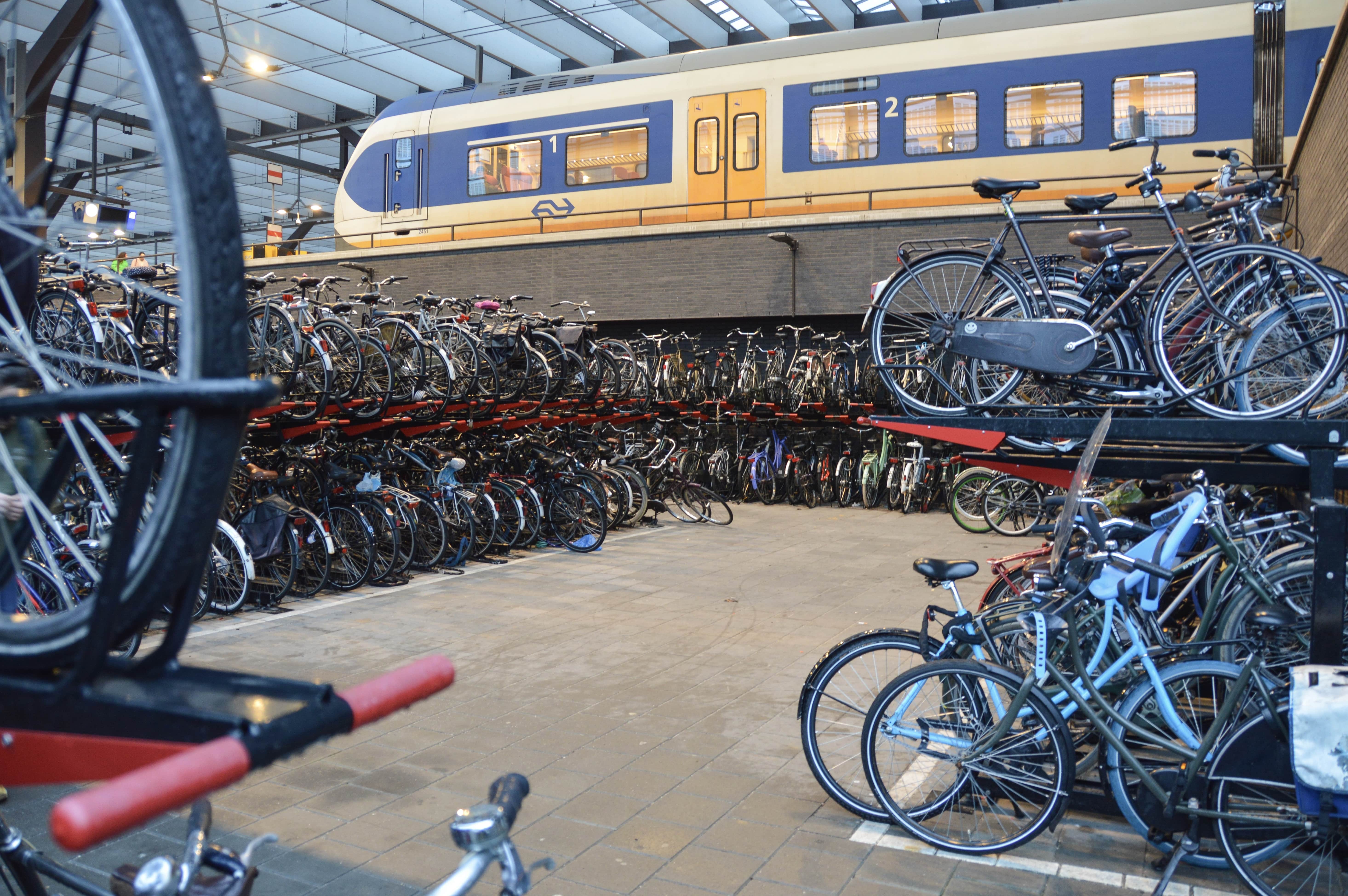
A bike-parking facility in Rotterdam Centraal station. © Dutch Cycling Embassy.
The future of cycling is one where the individual mobility devices that people use are as unique as the people who use them. Two-, three-, and four-wheeled adapted machines that reflect a wide variety of shapes and sizes: hand-powered cycles, recumbent cycles, and side-by-side cycles. But in order for this to reach its full potential, the infrastructure must be designed in an inclusive and intuitive way, applying many of the best practices developed in the Netherlands: including mountable curbs and plentiful curb cuts, smooth asphalt, lane width, visual cues and edges, and gentle gradients for bridges and underpasses. We will continue to export and translate these best practices to cities and regions across the globe.
Which moment of the previous editions of Velo-city impressed you the most or do you remember with particular pleasure?
The Bike Parade is, without fail, an exhilarating climax to the conference, with thousands of locals joining attendees for a rolling celebration through the city. The Dutch delegation is always well-represented and highly visible, with orange shirts and caps, ringing our bells and waving to everyone on the side of the road. After talking endlessly about bikes in the prior three days, it’s definitely nice to get to ride one in a social and stress-free situation!
What can attendees expect from your presence at Velo-city 2025? And what are you most looking forward to during the conference?
Velo-city brings all sorts of people in cycling and sustainable urban development. This leads us to having a variety of conversations on the problems that people encounter out on the bike and in the process of infrastructure planning. The diversity here makes us discover new perspectives and encourages us to think out of the box. Everyone here is so accessible and enthusiastic which makes exchanging knowledge much easier than in other contexts.
 The Dutch Cycling Embassy's delegation gathered before the bike parade during Velo-city 2024 Ghent. © Dutch Cycling Embassy.


